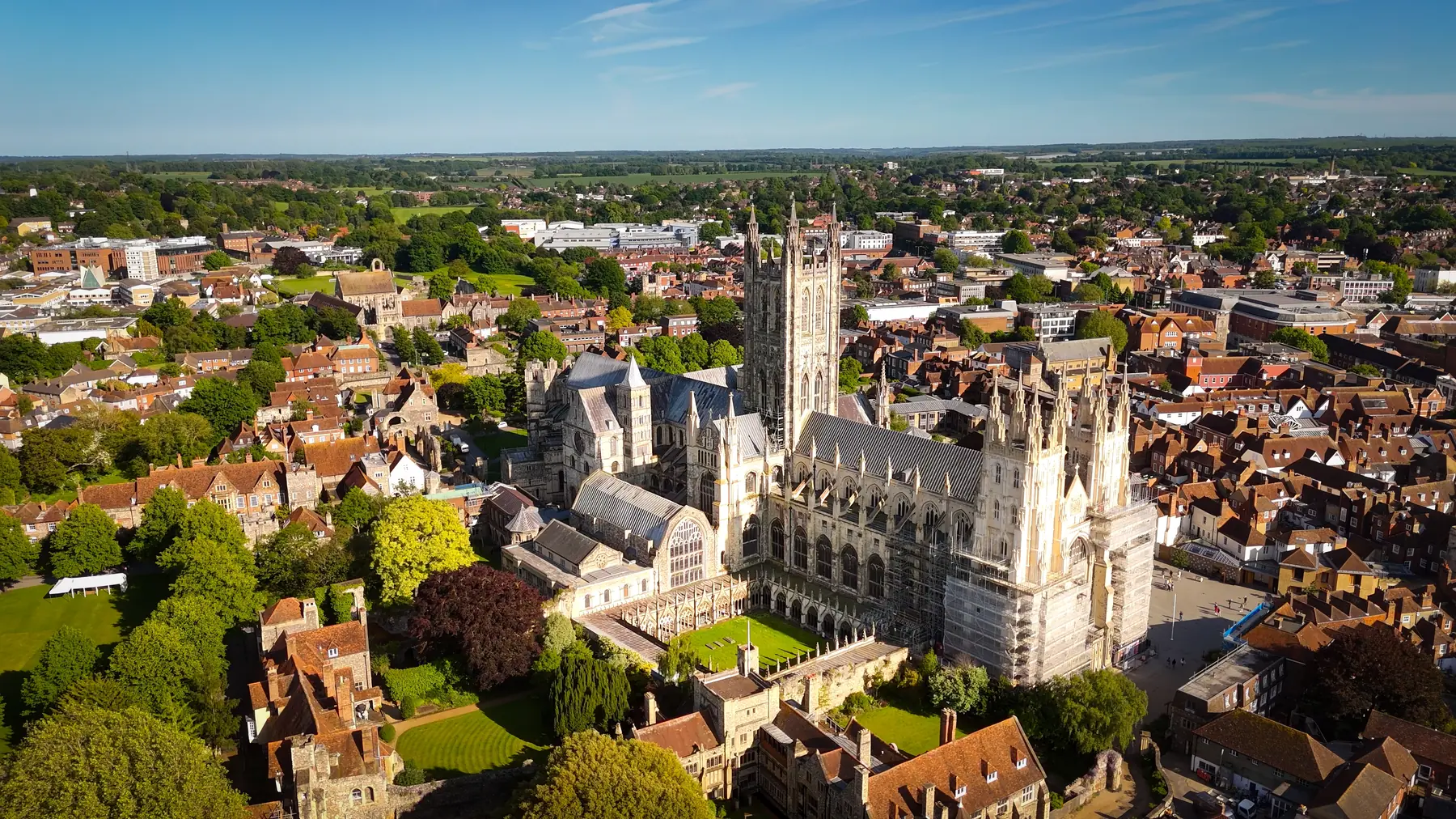
Canterbury Cathedral is the mother church of the Anglican Communion, the seat of the Archbishop of Canterbury, and the reason this city exists in the form it does. It has been a place of pilgrimage since 1170, when four knights murdered an archbishop in the north-west transept and turned a working cathedral into the most important shrine in northern Europe.
Visitors routinely say they wish they had allowed longer. Three hours is a realistic minimum if you want to see the building properly rather than walk through it; many people find the cathedral is their whole day and are not sorry about it. This guide sets out what to look for and in what order.
St Augustine arrived in Kent in 597 on a mission from Rome and founded a cathedral here — the first in England. Almost nothing of that building survives; the present cathedral is essentially two great campaigns of work laid on top of each other.
The crypt is the oldest substantial part, Norman and Romanesque, low and heavy, with carved capitals that reward a torch.
The quire and east end were rebuilt after a fire in 1174 by William of Sens and then, after he fell from the scaffolding, by William the Englishman. What they produced is the earliest full-blooded Gothic architecture in England, and it was built in a hurry because the cathedral needed somewhere spectacular to house Becket’s shrine.
The nave was rebuilt in the late fourteenth century in the Perpendicular style by Henry Yevele, the great royal mason of the age. Walking in through the west door and looking up its length is the single best moment in the building.
Bell Harry, the central tower, went up around 1500 and is the thing you see from every approach to the city.
The cathedral was bombed during the Second World War, along with much of the city around it. The library took a direct hit; the cathedral itself survived, and the medieval glass survived because it had been removed for safekeeping.
The north-west transept, where Thomas Becket was killed on 29 December 1170 by four knights who had taken Henry II’s exasperated remarks rather too literally. It is marked simply, with a modern sculpture of sword points. It is a small space and the quietest part of the cathedral, which is appropriate.
Go down. The Romanesque crypt is the oldest part of the building and one of the largest in the country, with carved capitals of animals and monsters, the chapel of Our Lady Undercroft, and a stillness that the rest of the cathedral cannot manage. Photography is generally restricted here.
Becket’s shrine stood here from 1220 until Henry VIII had it destroyed in 1538. The place where it stood is now marked by a single candle on a bare pavement — one of the most effective pieces of curation in any English cathedral. Around it, the floor is worn into hollows by four centuries of pilgrims’ knees.
The medieval stained glass in the Trinity Chapel tells the stories of cures attributed to Becket, in panels of extraordinary quality. Some of it dates from the twelfth century and is among the oldest surviving glass in England. Take binoculars if you have them, or use the cathedral’s own guides — this is the detail most visitors walk straight past.
Edward of Woodstock, the Black Prince, is buried in the Trinity Chapel under a gilt-bronze effigy, with replicas of his funeral achievements above. Henry IV is nearby with his queen, Joan of Navarre — the only monarch buried at Canterbury.
The quire screen, the medieval stalls, and the long view down the Perpendicular nave. Look up at the vaulting under Bell Harry, which is one of the finest fan vaults in the country.
The cloister vault carries hundreds of carved and painted bosses, many of them heraldic. The Chapter House is a large, calm, wooden-roofed hall that has been used as a film set more than once.
The cathedral charges for admission and the ticket includes access to the precincts, the nave, the quire, the crypt and the Trinity Chapel. Audio guides are available and worth it for a first visit; guided tours led by the cathedral’s own guides go into considerably more depth.
Tower tours climb the Corona Tower at the east end for a view over the precincts and the city — book ahead, and note that they involve a spiral staircase.
Services are free to attend. Evensong, sung most days in term by the cathedral choir, is not a concession or a compromise — it is the building doing what it was built for, and it is the best free hour in Canterbury. Arrive a little early and expect the visitor route to be closed while it happens.
Opening varies. Services, ordinations, enthronements and events all close sections at short notice. Check the day’s arrangements before you plan around it.
The cathedral is one of three parts of the Canterbury UNESCO World Heritage Site. The other two are close and both are worth combining with a visit.
St Augustine’s Abbey, five minutes east, was founded in 598 as the burial place of the early archbishops and kings of Kent, and functioned until its dissolution in 1538. It is a ruin, but a legible one, with a good modern museum.
St Martin’s Church, ten minutes further, is the oldest church in the English-speaking world still in continuous use, dating from before Augustine arrived — Queen Bertha, the Christian wife of the pagan King Æthelberht, worshipped here.
Doing all three in a day gives you the whole story of how Christianity arrived in England, in about two square kilometres.
Entry is through Christ Church Gate on Burgate, which is itself worth stopping to look at.
Accessibility. The nave and much of the ground level are accessible; the crypt and the towers involve steps.
Photography is permitted in most of the cathedral but restricted in the crypt.
Quiet. It is a working cathedral with an active community. Prayers are said on the hour and visitors are asked to pause.
Getting there. Both railway stations are under ten minutes’ walk. Do not attempt to drive to it — use park and ride.
The reason Canterbury became the greatest pilgrimage centre in northern Europe is worth spelling out, because it explains the city as well as the building.
Becket was killed in December 1170 after a long and bitter quarrel with Henry II over the relationship between crown and church. Within days there were reports of miracles. He was canonised in 1173; the following year Henry walked barefoot through Canterbury and was whipped by the monks in the crypt as public penance. By the end of the century the shrine was drawing pilgrims from across Europe, and the offerings they left paid for a great deal of what you now walk through.
Two hundred years later Geoffrey Chaucer used that traffic as the frame for the Canterbury Tales, written around 1387: a company of pilgrims riding from Southwark to the shrine, telling stories to pass the time. The poem is the reason a great many people know Canterbury’s name at all, and there is an immersive attraction in the city built around it.
The shrine itself lasted until 1538, when Henry VIII had it destroyed, the bones removed and the treasure carted away. What survives is the empty space, the worn pavement, and the candle.
Early morning, as soon as the visitor route opens, is the quietest hour of the day and the best light in the nave. Mid-afternoon is the busiest, particularly in July and August when coach parties arrive. Evensong, sung most days in term, is free and empties the building of everyone except those attending.
Winter is much quieter than summer and the cathedral is at its most atmospheric in low light. Advent and Christmas bring a full programme of services and music and are worth planning around.
Two hours as a minimum, three to do it properly, and more if you take a tower tour or a guided tour.
No, there is an admission charge for visitors. Attending a service, including evensong, is free.
In the north-west transept, now known as the Martyrdom, on 29 December 1170.
No. It was destroyed in 1538 on Henry VIII’s orders. Its site in the Trinity Chapel is marked by a single candle.
St Augustine’s Abbey and St Martin’s Church, both within fifteen minutes’ walk.