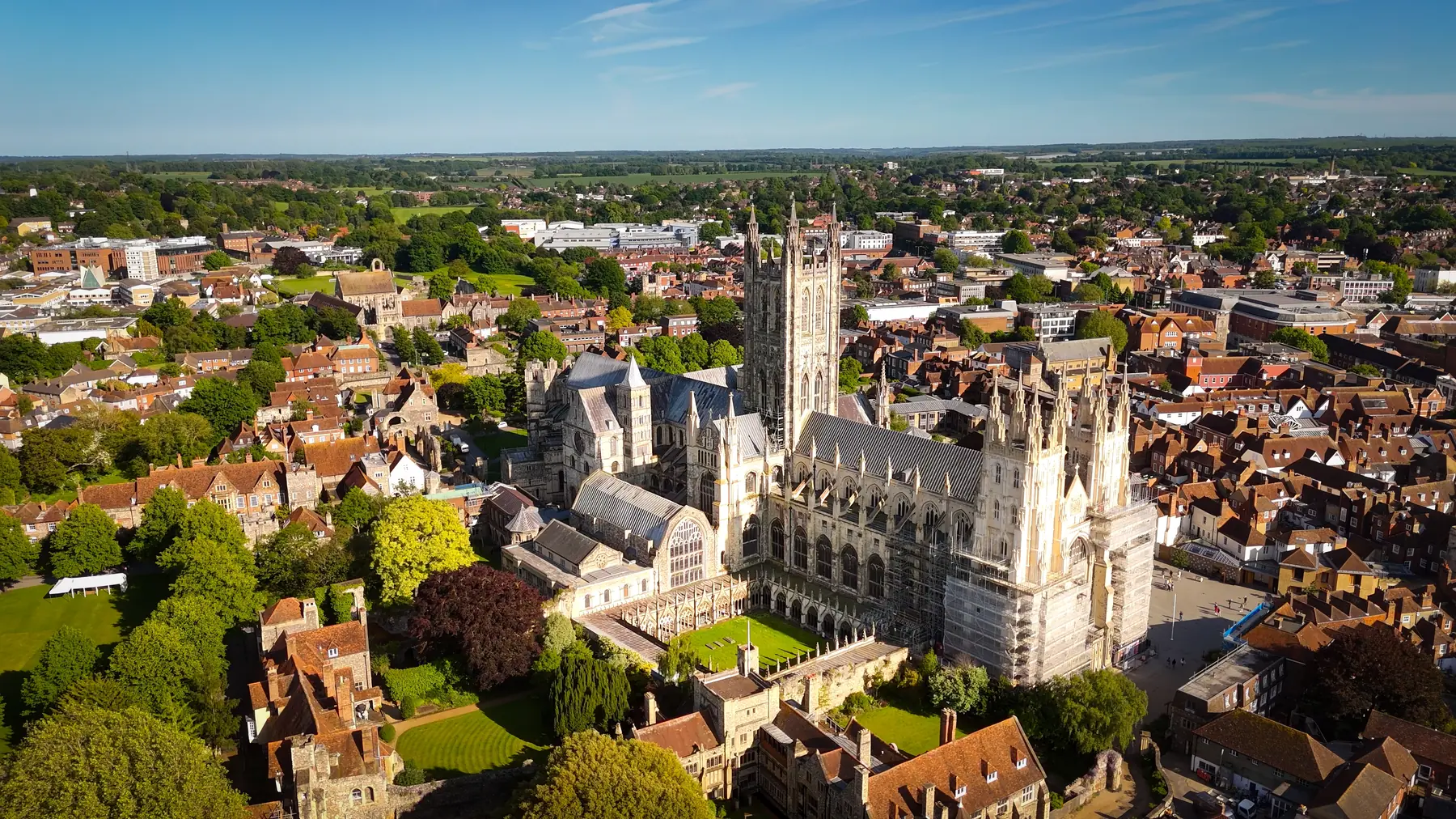
Canterbury sits at the centre of East Kent with the sea on three sides of it and a good railway. Whitstable is twenty minutes north, Dover half an hour south-east, the Thanet coast forty minutes east, and Ashford — with its Eurostar connection — half an hour south-west. Almost everything below can be done by train or bus, which makes Canterbury one of the better car-free bases in England.
The A2 runs from London through Canterbury to Dover, and the A28 goes east to Margate and Ramsgate and west to Ashford. The roads are decent; the coast in high summer is not.
Ten kilometres north, and the obvious first trip. Whitstable has been an oyster town since Roman times, and the working harbour, the fish market, the beach huts and the shingle beach have made it fashionable without quite ruining it. The Street, a shingle spit that emerges at low tide, lets you walk out into the estuary. Eat oysters, walk to Tankerton and back, and get the bus home. It is also walkable from Canterbury on the Crab and Winkle Way, eleven kilometres along the world’s first regular passenger railway line.
Eleven kilometres north-east. A Victorian seaside town with a clock tower, a stub of pier and the remains of the original pier head standing offshore. Quieter and cheaper than Whitstable, with sand at low tide and a good little seaside museum.
Fourteen kilometres north-east, and the most dramatic sight in this part of Kent. The twin towers of a ruined Norman church stand on an eroding cliff inside the walls of a third-century Roman fort, at what was the northern end of the Wantsum Channel that once separated Thanet from the mainland. It is free, it is exposed, and it is far better in bad weather than in good.
Forty minutes east. The Turner Contemporary gallery on the seafront, the restored Dreamland amusement park, the Old Town’s independent shops, and the Shell Grotto, a passage entirely lined with shells whose origin nobody has satisfactorily explained. Margate has been through a spectacular decline and an equally spectacular revival, and it is now one of the most interesting places in the south-east.
Broadstairs has Viking Bay, a proper sandy beach and heavy Dickens associations. Ramsgate has the only Royal Harbour in the country and a great deal of Regency architecture. Both are half an hour to forty minutes from Canterbury.
Thirty kilometres, and half an hour by train from Canterbury East. Dover Castle is one of the great English fortresses, with a Roman lighthouse, a Norman keep and — the reason to go — the wartime tunnels cut into the cliff, from which the Dunkirk evacuation was directed. Several hours, largely underground.
The White Cliffs themselves are National Trust land with a clifftop walk east towards the South Foreland Lighthouse and St Margaret’s Bay. On a clear day France is plainly visible.
Two castles built by Henry VIII, a shingle beach, a pier and one of the nicest small high streets in Kent. Around forty minutes.
Twenty-five kilometres east. A medieval Cinque Port that silted up and was left behind, which is why it still looks medieval — narrow streets, timber buildings, a quay on a river that no longer reaches the sea in the same way. The Sandwich and Pegwell Bay nature reserve and three championship golf links are next door.
Faversham, fourteen kilometres west, is a market town with a preserved medieval centre, a creek, and Shepherd Neame, Britain’s oldest brewery, which runs tours. The Oare Gunpowder Works country park is on the edge of town.
Beyond it, the orchards and hop country of mid-Kent, and Leeds Castle near Maidstone — a castle on two islands in a lake, one of the most photographed buildings in England, around forty-five minutes away.
The Kent Downs rise immediately south of Canterbury. The Wye Downs and the Devil’s Kneading Trough, fifteen kilometres out, give the best views in east Kent. Further south, Chilham is a village so photogenic it has been used as a film set repeatedly, with a square, a castle and a church.
Ashford, twenty-one kilometres south-west, has the Eurostar station — which means Lille and Paris are technically day trips from Canterbury, if unusual ones.
This is Canterbury’s strong suit. The city has two railway stations, both under ten minutes’ walk from the centre. Canterbury West has the high-speed service to London St Pancras in around fifty minutes and connections east to Ramsgate and Margate; Canterbury East runs south to Dover and west towards London Victoria. Trains are frequent, though services thin at weekends and on bank holidays — worth checking if you want a late return.
Buses cover what the trains do not: Whitstable, Herne Bay, Reculver, Faversham, Sandwich and the Downs villages all have services from the bus station in the middle of the city. Our getting here page has Canterbury West, Canterbury East and the bus station in one place.
The coast day, no car. Train or bus to Whitstable in the morning for the harbour and the Street, walk east along the shore through Tankerton and Hampton to Herne Bay for lunch, then bus on to Reculver for the towers in the late afternoon light. Three seaside towns and about eight kilometres of walking, entirely on public transport.
The Dover day. Train from Canterbury East, Dover Castle and the wartime tunnels through the middle of the day, then the clifftop walk east to South Foreland Lighthouse and St Margaret’s Bay. Back by train. One of the best full days in the south-east.
The Downs and villages day. South-west by car through Chartham and Chilham — stop for the village square — then on to Wye for the Downs and the Devil’s Kneading Trough, and back through Godmersham. Slow lanes, big views and almost no visitors.
The Kent coast in July and August is genuinely busy, and Whitstable in particular has become a weekend destination for London. Going midweek, or going late in the day, transforms all of these trips. Canterbury’s own peak is the summer and the October festival; the city is at its most pleasant in May and September.
The geography here rewards paying attention. The north Kent coast — Whitstable, Herne Bay, Reculver — sits in the Thames estuary rain shadow and is one of the driest places in Britain; it frequently stays clear when the Weald to the south is under cloud. The Downs to the south catch more weather but drain fast, so they are the better bet after rain. And Dover Castle, being largely underground, is entirely weather-proof.
Seasonally: the coast is at its best in late spring and September, when the light is good and the crowds have gone. Margate and Broadstairs are properly busy in August. The orchards west of Canterbury are worth a drive in blossom time in late April, and the hop gardens and oast houses look their best in September.
Whitstable for a half day, Dover Castle for a full one, Margate if you want a city-scale day out.
Ten kilometres to Whitstable, eleven to Herne Bay, about thirty to Dover.
Yes, directly from Canterbury East in around half an hour.
Yes, but it is the furthest of these at around forty-five minutes and deserves most of a day.
Ashford International is half an hour away with Eurostar services, and the Dover ferries run to Calais. It is a long day but a possible one.