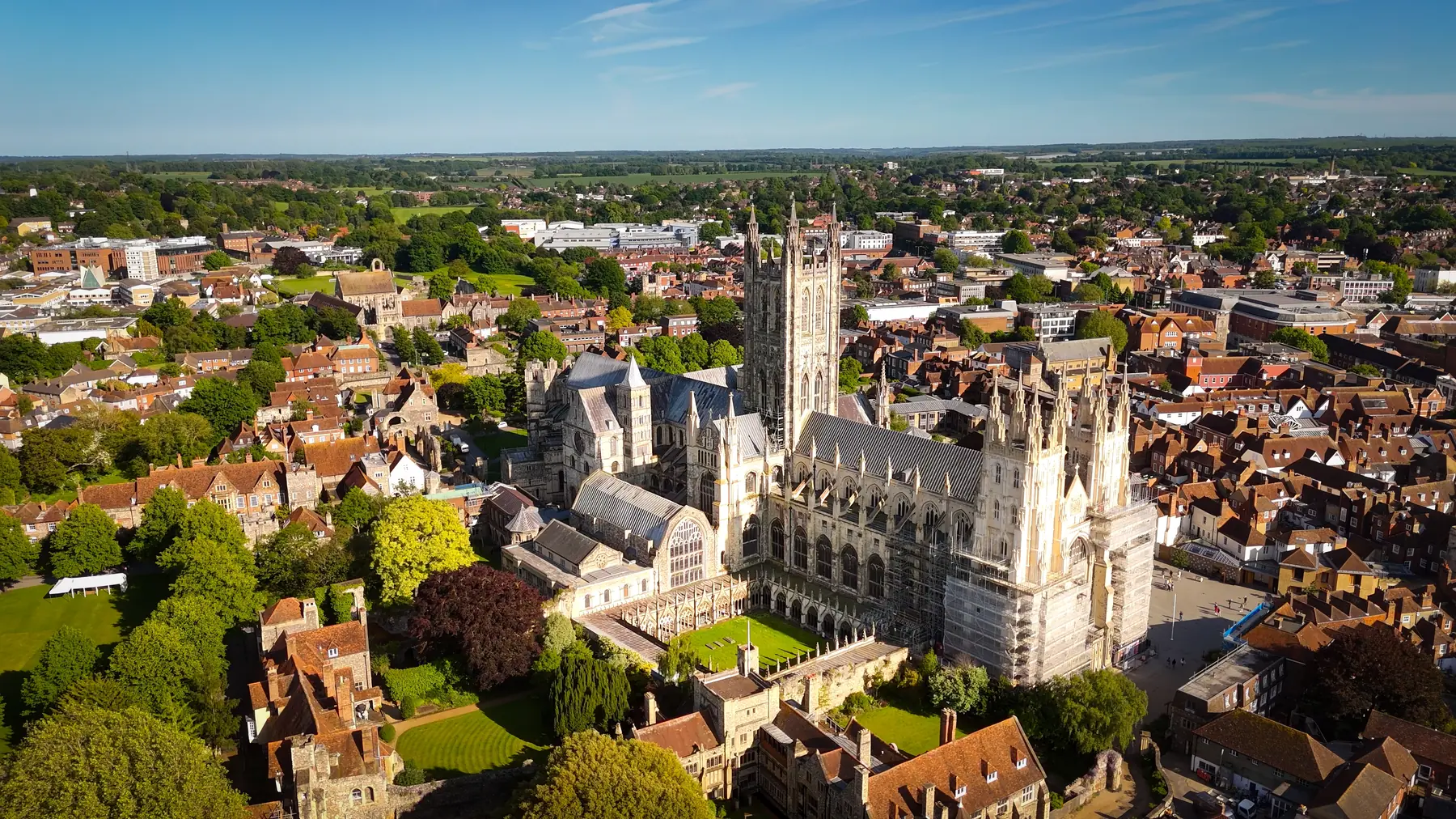
Canterbury has a reputation for being expensive to visit, and the reason is specific: the cathedral charges, and it charges properly. Once you have paid for a family to go in, the day has cost something. But the cathedral is one building in a city with two thousand years of layers, and a very large amount of what makes Canterbury interesting is free — the walls, the gardens, the oldest church in the English-speaking world, an excellent free museum, and some of the best woodland and wetland walking in Kent.
The city’s museum and art gallery, on the high street, free to enter. It holds the Royal Museum collections, the city’s art, natural history, a library and a café, all inside a Victorian mock-Tudor building that is worth looking at from the outside as well. It is the best free thing in Canterbury and a good deal of the city’s own population uses it as a place to sit.
Around half the Roman and medieval wall circuit survives and much of it is walkable. The Dane John Gardens inside the southern wall are free and built around a mound with three lives — Roman cemetery, Norman motte, Victorian public garden — with a monument on top and a view over the city from it.
Free, and the loveliest place in Canterbury. The Great Stour runs through it in several channels, there are willows and an enormous oriental plane tree, and the walk continues along the river out of the city.
Ten minutes east of the centre, and the oldest parish church in the English-speaking world still in use — in continuous use since the sixth century, and part of the same UNESCO World Heritage Site as the cathedral and St Augustine’s Abbey. It is small, plain and free, and it is where Christianity in England effectively starts.
Two small riverside gardens in the middle of the city, both free, both quiet, and both missed by most visitors. The Franciscan Gardens contain Greyfriars Chapel, built over the river on arches.
The precincts require a ticket, but the cathedral is visible from a great many places for free — from Butchery Lane, from the Dane John mound, from the Westgate Towers’ street, and best of all from the top of the multi-storey car parks. Attending a service, including evensong, does not require an admission ticket.
Blean Woods, four and a half kilometres north, is one of the largest ancient woodlands in England, with free RSPB waymarked trails, bluebells in late April and nightingales in May.
Stodmarsh National Nature Reserve, north-east along the Stour, has free access to hides and boardwalks over one of the best wetland bird sites in the south-east — marsh harriers, bitterns and bearded tits.
The Crab and Winkle Way runs eleven kilometres from the city to Whitstable along the trackbed of the world’s first regular passenger steam railway, opened in 1830. Free to walk or cycle, with a bus back.
The Great Stour to Fordwich is a flat five-kilometre riverside walk to what claims to be the smallest town in England.
The Kent Downs to the south, including the Wye Downs and the Devil’s Kneading Trough, are free open countryside with the best views in east Kent. Our walks guide has the routes.
Whitstable, Herne Bay, Hampton and Reculver are all within fourteen kilometres and all free once you are there. Reculver in particular — a ruined twelfth-century church with twin towers standing inside the walls of a third-century Roman fort on a cliff edge — is one of the most striking free sights in the south-east.
The Street at Whitstable, a shingle spit that emerges at low tide and lets you walk out into the sea, costs nothing and is worth timing a visit around.
Canterbury has a general market on the high street and a farmers’ market at the Goods Shed by Canterbury West station, which is a covered permanent market rather than a weekly one and free to walk round. The Canterbury Festival in October fills the city with events, some of them free and outdoors.
The university adds public lectures, exhibitions and concerts through term time, a good many of them open to anyone.
The unavoidable costs are the cathedral and parking. The cathedral is worth its ticket and there is no way round it if you want to go inside — though a service is free.
Parking is more tractable. Park and ride at Wincheap, New Dover Road or Sturry Road charges a flat daily fee that covers the driver and up to six passengers on the bus, with a cheaper rate from late afternoon; it is far cheaper than a day in a central car park and quicker than looking for one. Better still, both railway stations are inside the walls, and the high-speed service from London St Pancras takes under an hour — Canterbury is one of the easiest cities in England to visit without a car.
Start at the Beaney on the high street, walk out through the Westgate to the gardens and along the river, then back through the lanes to the Dane John and up the mound for the cathedral view. Take lunch in the market or on the grass. In the afternoon, walk the wall circuit and out to St Martin’s Church and the outside of St Augustine’s Abbey, then finish at evensong in the cathedral — free, forty minutes, and the building at its best.
Canterbury’s calendar is unusually generous. The Canterbury Festival in October fills the city for a fortnight and, while the main programme is ticketed, a substantial fringe of street performance, exhibitions and open venues is not. The Medieval Pageant in the summer brings a costumed procession through the streets, free to watch. And the two universities put on public lectures, exhibitions and student concerts through term time, most of them open to anyone who turns up.
The cathedral also opens free on certain occasions and always for worship. Christmas and Easter services, carol singing in the precincts and the Advent procession are all free to attend and are the building at its most impressive.
Worth checking what you already hold. St Augustine’s Abbey is English Heritage; the White Cliffs of Dover, South Foreland Lighthouse and a number of Kent properties are National Trust. Neither covers the cathedral, which is independent, but for a week in east Kent an existing membership changes the arithmetic considerably.
If you have longer, the free version of Canterbury extends well past the city. Take the bus to Whitstable and walk the shore east through Tankerton and Hampton to Herne Bay — six or seven kilometres of free coast, with the Street emerging at low tide if you time it. Or take the bus to Reculver and walk the sea wall, which is free, exposed and among the most striking places in Kent.
Inland, Blean Woods in bluebell season and Stodmarsh in winter are both free, both substantial, and both reachable without a car. That is two more full days without an admission ticket.
Being fair about it: the cathedral is worth its ticket, and if you only pay for one thing in Canterbury it should be that. After it, the Roman Museum gives the best sense of the city’s depth, and a punt trip gives the best sense of its shape. Everything else on this page is free, and there is more than enough of it for a long weekend.
No, there is an admission charge, but attending a service including evensong is free.
The Beaney House of Art and Knowledge on the high street.
Yes. Roughly half the circuit survives and the walkable sections are open.
Not in the centre. Park and ride is the cheap option and is the one locals recommend.
Westgate Gardens, Dane John, Toddler’s Cove playground, Blean Woods and the beaches at Whitstable and Herne Bay.