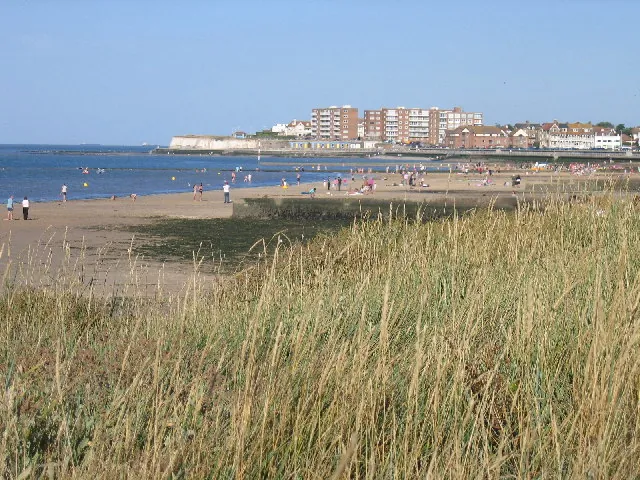
Birchington is a village and civil parish in the Thanet district of Kent, on the coast between Herne Bay and Westgate-on-Sea, with 10,394 residents at the 2021 census. Its railway station is called Birchington-on-Sea; the village’s own name is just Birchington.
It lies 19.1 km from Canterbury in a straight line. road distances only to its neighbours — 9 miles (14.5 km) east of Herne Bay, 4 miles (6.4 km) west of Margate — but the A28 from Hastings to Margate runs through both Canterbury and Birchington.
Visitors come for one of two things, on opposite sides of the village: Quex Park, a manor estate with a natural history museum in it, to the south; four bays under chalk cliffs to the north. Between them is a shopping street and a village where 39.5 per cent of residents were 65 or over in 2021, against 18.4 per cent nationally. A visitor at Minnis Bay in March 2022 counted the quiet against it: “There are only a few shops etc so a much quieter place, which won’t suit some people”.
Quex House is a 200-year-old manor house in 250 acres (1.0 km²) of parkland, built to replace a Tudor house pulled down early in the 19th century; several rooms of period furniture are open to visitors. The museum inside it is what most people come for. Percy Powell-Cotton founded it here in 1896 to hold what he brought back from expeditions that sometimes ran to 18 months: three galleries of dioramas holding more than 500 African and Asian animals, mounted by the taxidermist Rowland Ward, alongside African artefacts, weapons and porcelain — the ethnography items alone number roughly 18,000. It rates 4.6 from 663 Google reviews.
Not everyone takes the collection at face value. A visitor in September 2023 wrote, “You do need to take into account the way the animals arrived at Quex which seems abhorrent now but was what was commonplace at the time.”
In the grounds stands the Waterloo Tower, built in 1818 by John Powell, then the owner of Quex Park, who had an interest in change ringing: the first twelve-bell tower in Kent. A visitor in May 2026 reported of the estate’s three towers that “they are all in a private area and cannot be seen by the public.”
The estate also carries an adventure farm park, an indoor playground, alpaca walks and a farm shop, and the mix divides people. A visitor in May 2026 found that “Quex Park isn’t slick or over-commercialised. It feels homely”; another the same month left after two hours, writing that “the site is hyped up in the media and is actually quite small.” Arrive early either way — one in August 2026, there with a daughter with complex disabilities, found the marked disabled parking “completely full, despite nearly every car not displaying Blue Badges.”
The village is built beside four partly sandy bays: Minnis Bay to the west, Grenham Bay and Beresford Gap in the centre, Epple Bay to the east. Eastwards the land rises into chalk cliffs and cliff stacks, with caves around the smaller beaches and a sea wall at their foot holding back erosion. The whole north-east Kent coast is a Site of Special Scientific Interest.
Minnis Bay is the family beach — sailing, windsurfing, cafés, beach huts, pubs, a playground and a paddling pool. It holds a European Blue Flag award and rates 4.5 from 1,250 Google reviews. Parking is easy: a visitor in July 2026 recorded “Free on road parking and pay and display car park at the back of the restaurants.” One in April 2026 found “Plenty of disabled access, which makes a good change”, with a caveat about the shared path — “please look out for the cyclists who think they own it.”
The tide is what to plan around. A visitor in August 2025 warned that “the tide comes in very fast and at high tide most of the beach is underwater”; one in April 2024 was blunter: “the tide came in super fast we got cut off on one of the stair ways onto the beach”.
Birchington was first recorded in 1240 as Birchenton, from the Old English bircen tun, a farm where birch trees grow, though Minnis Bay was an Iron Age settlement long before that. All Saints’ Church dates to around 1350; Quex Park manor house was built just south of the village in the early 15th century, named after the park’s second owner, John Quek, and passed to the Powell family in 1770. In 1565 commissioners reporting to Elizabeth I recorded 42 houses and no active port.
What it had instead was smuggling. Before the 19th century the coastline was frequented by smugglers, with skirmishes against excise officers, and several of the older houses still contain cellars and bricked-up tunnels once used to store contraband. The population was 537 in 1801, and farming carried the village until the railway made it a resort: the station opened in 1863 and Station Road was laid out afterwards as the shopping street.
On 4 February 1882 Dante Gabriel Rossetti came to Westcliff Bungalow, a friend’s house here, to recover from ill health. He died on 10 April, Easter Sunday, and was buried in the churchyard of All Saints under a tombstone designed by Ford Madox Brown.
By road the A28 is the direct link, running from Hastings to Margate via Ashford, Canterbury, Birchington and Westgate-on-Sea.
Without a car, the bus is the verified connection: Stagecoach South East runs services from Birchington to Canterbury, and to Westgate-on-Sea, Margate, Broadstairs and Herne Bay. No route numbers or frequencies are recorded, so check with the operator before setting out.
Rail does not join the two directly. Birchington-on-Sea station is on Southeastern’s Chatham Main Line between Ramsgate and London Victoria, via Margate, Herne Bay, Faversham and Chatham; Canterbury is not a stop on it.
Nor does the pack show a walking or cycling route between the city and this coast. The Viking Coastal Trail cycle path a visitor described in November 2025 runs along the shore past Minnis Bay, not inland.
The village and what is around it, at walking scale.
Open any of them in Google Maps for directions and current opening.
Attractions, prices and availability in Canterbury
These come from GetYourGuide's booking widget, which sets their cookies in your browser. Consent to load it and see the attractions and prices.
Background on Birchington-on-Sea draws on its Wikipedia article, text there being available under CC BY-SA 4.0.