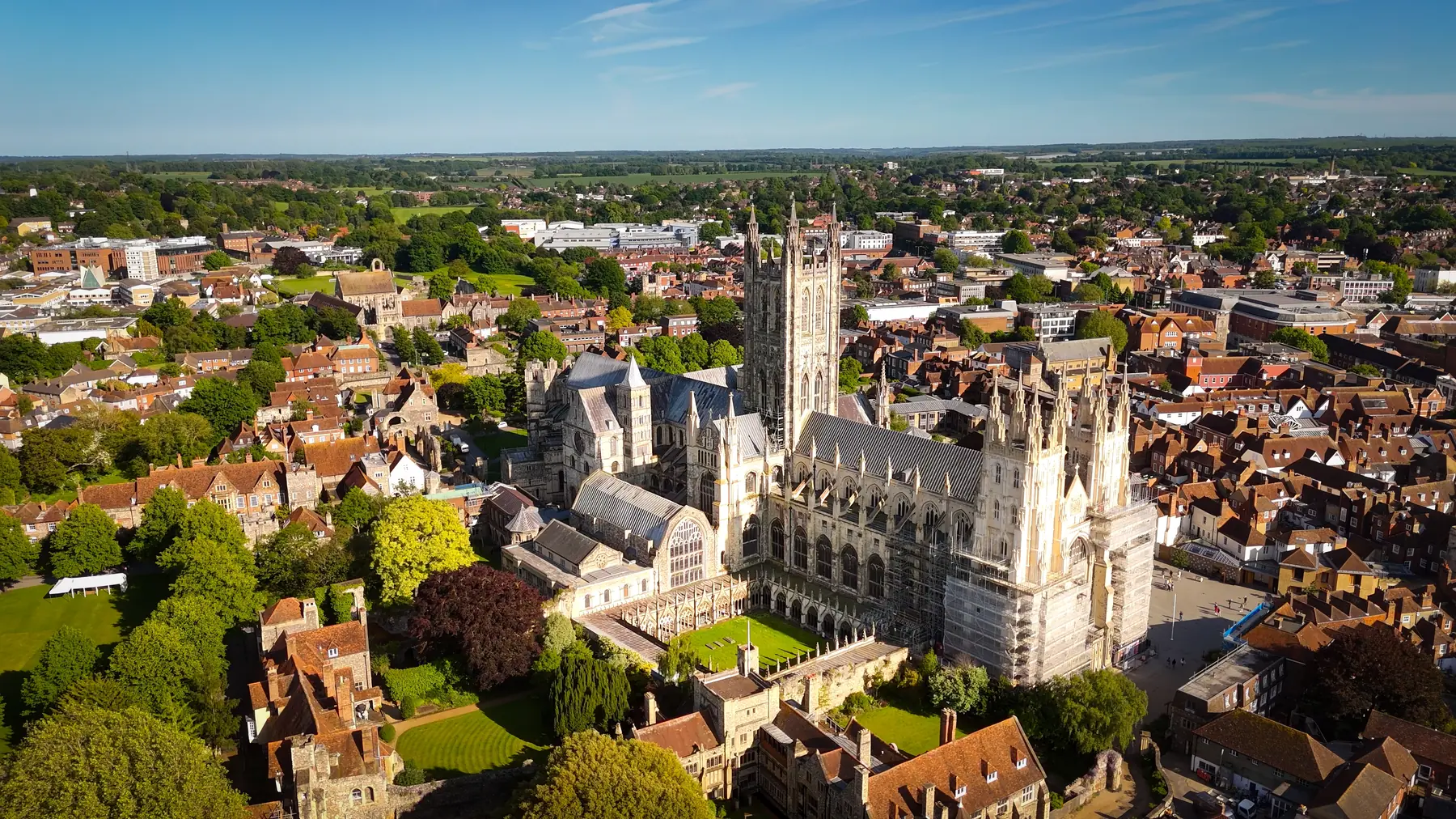
Canterbury handles rain better than most English cities, for the simple reason that it has spent two thousand years building things with roofs on. The cathedral alone will absorb three hours. Underneath the high street there is a Roman house with its mosaic floor intact. The museums are good, the covered lanes of the medieval centre are short, and the pubs are numerous and old.
There is also the fact that this is a compact city. Nothing in the centre is more than ten minutes’ walk from anything else, which means a wet day here involves a great deal less time outdoors than a wet day almost anywhere comparable.
Start here. Canterbury Cathedral is the mother church of the Anglican Communion, the seat of the Archbishop of Canterbury, and a building that visitors routinely describe as needing at least three hours to do properly. The nave, the quire, the crypt, the Trinity Chapel, the medieval stained glass and the site of Thomas Becket’s murder in 1170 are all under cover, and the tower tours take you further up into it.
It is a working cathedral with a full service schedule, so parts of it close at times — evensong in particular is worth attending rather than avoiding. Our cathedral guide sets out what to look for and how long to allow.
Built underground, around a Roman mosaic pavement uncovered after wartime bombing destroyed the buildings above it. You descend to the level of the Roman street of Durovernum Cantiacorum and walk past the remains of a courtyard house. It is compact, it is genuinely subterranean, and it makes the point about the city’s age better than any amount of signage. Some visitors find the entry price steep for the size; it is nevertheless the most interesting forty minutes in the city on a wet day.
On the high street, free to enter, and much better than most people expect: the city’s art collection, the Royal Museum, natural history, a library and a café, in a Victorian mock-Tudor building that is worth a look in itself. The single best free wet-weather hour in Canterbury.
An indoor walk-through of Chaucer’s stories with sets, sound and actors. It was substantially reworked in recent years and the current version is well regarded, including by people who remember the old one without affection. About an hour.
An unexpected one, near St Peter’s Place, free and rather good — the largest collection of its kind outside London, in a purpose-built masonic hall.
The largest surviving medieval city gate in England, with a small museum inside and a viewpoint at the top. The view is the point, so it is a better proposition in a shower than in a downpour.
St Augustine’s Abbey, five minutes east, was founded in 598 and is largely ruin, but the museum on the site is modern and dry, and the audio guide is good. St Martin’s Church, a little further, is the oldest church in the English-speaking world still in use — small, plain and remarkable.
The Old Weavers House on the river and the Wetherspoon in the medieval Burgate building are both places where the architecture is the reason to go in.
Canterbury’s high street runs the length of the old city and much of the retail sits in the Whitefriars centre, which is at least partly covered. More interesting are the lanes off it — Palace Street, The Borough, Butchery Lane, Sun Street — narrow, crooked, full of independent shops, and short enough to dart between doorways.
The Goods Shed at Canterbury West station is the one to plan around: a Victorian railway shed converted into a permanent farmers’ market with a restaurant in it. Produce, cheese, bread, fish, and somewhere warm to eat it. It is the best wet lunchtime in the city.
Howletts Wild Animal Park at Bekesbourne works in rain up to a point — the animals are outdoors and so are you, but the site is large and the elephant and gorilla houses give shelter.
Faversham, fourteen kilometres west, has the Shepherd Neame brewery, the oldest in the country, with a visitor centre and tours.
Whitstable and Herne Bay, ten and eleven kilometres north, are both better in bad weather than they sound: a seafood lunch in Whitstable while the rain comes off the estuary is a genuinely good way to spend an afternoon, and Herne Bay has a seaside museum.
Dover, thirty kilometres south-east, has the castle with its extensive wartime tunnels cut into the cliff — several hours underground and one of the best rainy-day destinations in Kent.
If you want to be outside, three options tolerate weather. Blean Woods has tree cover and drains reasonably. Westgate Gardens and the riverside are short enough to abandon. And Reculver, on the coast, is better in a gale than in sunshine — the twin towers on the cliff edge with the sea coming in is a considerably more impressive sight in bad weather.
Avoid the Stour footpaths east of the city after heavy rain; the water meadows do what water meadows do.
Park and ride is the answer to a wet day as much as a dry one — the three sites at Wincheap, New Dover Road and Sturry Road put you in the centre without a walk from a distant car park. Buses run every few minutes Monday to Saturday, less often on Sunday, and Wincheap does not operate on Sundays at all.
Trains run to both Canterbury stations, each under ten minutes from the centre, with a high-speed service from London St Pancras in around fifty minutes.
Cathedral opening varies with services and events. Check before building a day around it.
The cathedral is the spine of any wet day here, and the question is what goes around it. The sequence that works: the Beaney first thing, which is free and five minutes from everything; the cathedral from mid-morning through lunchtime, which is when it is at its quietest before the afternoon coach parties; lunch at the Goods Shed by Canterbury West or in one of the old inns; then the Roman Museum underground in the early afternoon; and evensong at the end of it, which is free, forty minutes and the best thing in the city.
That is a full day, almost entirely indoors, with no journey longer than ten minutes on foot. Very few English cities can offer the same.
Two things worth knowing. The north Kent coast is one of the driest parts of Britain — the Thames estuary sits in a rain shadow, and Whitstable, Herne Bay and Reculver frequently stay dry while the Weald to the south is under cloud. If Canterbury is wet, the coast is worth a look before you write the day off.
And the Stour floods. The water meadows east of the city are meant to flood, and the riverside paths towards Fordwich go under after sustained rain. The punts stop running when the river is high, which is the practical signal that the paths are unusable too.
Canterbury is well supplied with places to wait out a shower without buying a ticket. The Beaney has a café and a library and no admission charge. The Goods Shed has a mezzanine over the market. The lanes off the high street — Palace Street, Sun Street, the Borough — are short enough that you can move between doorways without getting soaked, and the independent bookshops and galleries along them are used to people coming in out of the weather.
The pubs, too, are the small, old, low-ceilinged kind rather than open-plan barns, and an hour in one of them with the rain on the window is a legitimate use of a Canterbury afternoon.
The cathedral for several hours, the Roman Museum underground, the Beaney for free, the Canterbury Tales, and the Goods Shed for lunch.
Yes, it is open year-round, though sections close for services and events.
The Beaney House of Art and Knowledge and the Kent Museum of Freemasonry are both free.
At least two hours, and three if you want the crypt and the glass properly.
Operators generally run in light rain and cancel in high wind or high water. Check on the day.