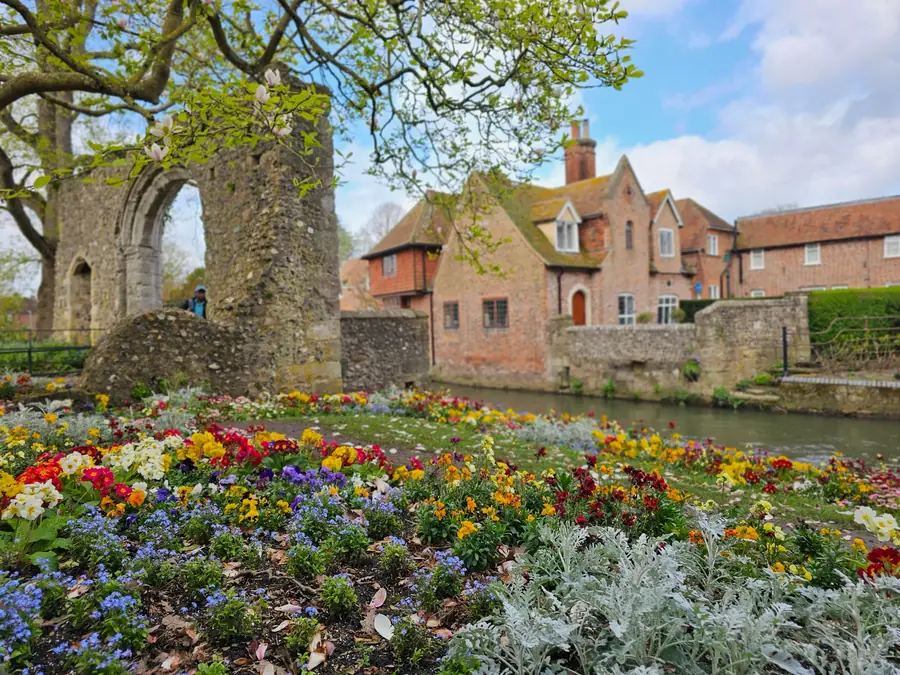
St Augustine’s Abbey stands five minutes east of the cathedral, outside the line of the old city walls, on Longport. It is the third part of Canterbury’s UNESCO World Heritage Site, with the cathedral and St Martin’s Church, and it is the one visitors most often skip. That is a mistake, but it is an understandable one. What you see is a ruin. What you are standing in is the monastery from which the conversion of the English was organised.
It is English Heritage. There is a modern museum, a very good audio guide, and more grass than standing wall. Allow an hour to ninety minutes. Do not treat it as a five-minute look through the fence.
Augustine landed in Thanet in 597, sent from Rome by Pope Gregory the Great, and was received by Æthelberht, King of Kent. Æthelberht’s wife, Bertha, was already a Frankish Christian; she worshipped at St Martin’s, a little further east, which is why that small church is older than the mission. The king gave Augustine a site for a monastery outside the Roman walls of the city. Roman custom placed burials outside a town. The abbey was founded in 598 as a burial church for the early archbishops and the kings of Kent, not as a rival to the cathedral inside.
That geography still explains the visit. You walk out through the walls, or along Longport from the bus, and the city drops behind you. The abbey is not a second cathedral. It is the cemetery, the monastery and the library of the mission that made the cathedral possible.
The first house was Anglo-Saxon: a cluster of churches built of reused Roman brick, on a plan you can still read on the grass. SS Peter and Paul, the main abbey church, was underway when Augustine died. St Mary’s was added to the east. St Pancras stood further east again. Early archbishops, including Augustine himself, were buried in the north porticus; Æthelberht and Bertha in the south.
The Normans razed most of that work in the late eleventh century and built a great Benedictine abbey church over it, with a crypt, a long nave and monastic ranges around a cloister. For the next four and a half centuries this was one of the most important religious houses in England. Its library was a serious collection. Its abbots were buried here alongside the kings.
Henry VIII dissolved it in 1538. The shrine of Augustine went the way of Becket’s in the cathedral the same year. The abbot’s lodgings were turned into a royal residence — Henry had it in mind as a palace for Anne of Cleves — and the rest was dismantled for stone. Demolition continued, in fits, until 1848. What standing masonry you see is what survived that long robbery, plus the nineteenth-century missionary college that occupied part of the precinct and, in doing so, stopped the rest being cleared.
English Heritage looks after the ruin and the museum. Other former abbey buildings nearby belong to King’s School and are not part of the ticket.
A ruin, but an unusually legible one. The ground plan of the Norman abbey church is laid out on the grass. The Anglo-Saxon churches beneath it are marked, so you are walking over two buildings at once. The cloister, the refectory and the crypt can be read on the ground even where the walls are a course or two of flint.
The north wall of the Norman nave is the standing fragment people photograph: a length of masonry that gives you the scale of the church, which was not a chapel. It was a rival, in length, to the cathedral over the wall.
The crypt is the bit that still feels like a building. Traces of decoration survive. It is the place to slow down after the open nave.
Graves of the early archbishops and of Æthelberht and Bertha are marked. They are not tombs you look into. They are the reason the site exists.
Take the audio guide before you start walking. Without it, this is a field of foundations with a good wall. With it, the successive churches stack on top of each other and the dissolution makes sense.
At the eastern end of the site, slightly apart from the main church, stands the ruined chapel of St Pancras. It is the fragment to walk to on purpose.
It is an early Anglo-Saxon church, built using Roman brick — reused from the city of Durovernum, set in courses you can still see. A fourteenth-century tradition held that Augustine said his first mass in Canterbury here, in a building then thought to be pagan. Modern archaeology is more cautious about the legend and more interested in the brick: this is some of the earliest surviving ecclesiastical fabric in England, whether or not it is quite as early as the tradition wanted.
One wall of the west porch stands nearly to its full height. The chancel arch reused Roman columns. It is a small building, and it is the one part of the abbey that still has the character of a church rather than a plan.
Because it sits at the far end of the precinct, some visitors turn round at the nave wall and miss it. Do not.
You enter through the museum. It is modern, dry and genuinely useful — the finds, the sequence of churches, the dissolution, the palace. Reviewers who thought the ticket fair usually mention this room and the audio guide, not an extra three metres of flint. Reviewers who thought it dear usually treated the ruin as a photograph from the pavement.
The audio guide is included with admission. Take it. Families report that it holds children’s attention, which is not a common outcome at a monastic ruin, and it is the difference between a field and a building. There are also, in season, guided walks led by English Heritage; those are extra, numbered, and listed on the property’s own what’s-on page.
There is no café on site. The city is five minutes away. Toilets and a shop sit by the entrance. The grass takes a picnic, and on a fine day that is the right way to use the precinct after the audio tour — the abbey was always a garden as well as a church.
Doing all three in a day is the best way to understand Canterbury, and it is a walk, not a drive.
Canterbury Cathedral — the mother church, five minutes west, inside the walls. Ticketed, vast, a full morning.
St Augustine’s Abbey — the monastery, here, outside the walls. English Heritage.
St Martin’s Church — ten minutes further east, the oldest church in the English-speaking world still in continuous use. Small, plain, free, and where Queen Bertha worshipped before Augustine arrived.
Together they cover the arrival of Christianity in England within about two square kilometres. A Canterbury World Heritage Pass covering the three has been offered in recent years, sold online and at the abbey or the cathedral. Whether it saves you money depends on what you already hold — English Heritage membership covers the abbey but not the cathedral, which is independent. Ask on the day; offers change.
St Martin’s is the one to leave until last if you are walking: it is the furthest, it is free, and it is the quietest.
English Heritage runs the site. Hours change with the season — daily in the main months, shorter days and some closed weekdays in winter. Last entry is before closing. Check the English Heritage page for St Augustine’s Abbey for the day you are going, not a third-party hours box.
Do not invent a price from this paragraph. Members go in on membership. Advance online tickets have, at times, been cheaper than the gate. A pass with the cathedral sometimes exists. The board and the official page are the tariff.
Time. An hour to ninety minutes with the museum and the audio guide. Reviewers who “popped in” regret it; reviewers who gave it the hour come out understanding the cathedral better.
Access. Largely level grass and gravel, with some uneven ground and a few steps at the crypt. Wear shoes that can cope with wet grass. It is an open ruin: a January visit is a coat and careful footing, not a wet-weather bunker. Pair it with the cathedral and the Roman Museum if the day is truly poor.
Dogs. Check the current English Heritage rule if that decides the day; historic ruins change the wording.
On foot: five minutes east of the cathedral along Longport, outside the walls. From the High Street it is closer than it feels on a map.
By train: Canterbury East is about ten minutes’ walk; Canterbury West about fifteen, through the city.
By car: do not. Use park and ride — New Dover Road is the nearer of the two council sites. Longport itself is not a car park. See parking in Canterbury.
The abbey is on the same eastern edge as St Martin’s and the city walls’ Burgate stretch. It sits naturally at the end of an old-town walk, or at the start of one if you want the ruin before the cathedral fills. Our walking guide to the old town puts it in that circuit.