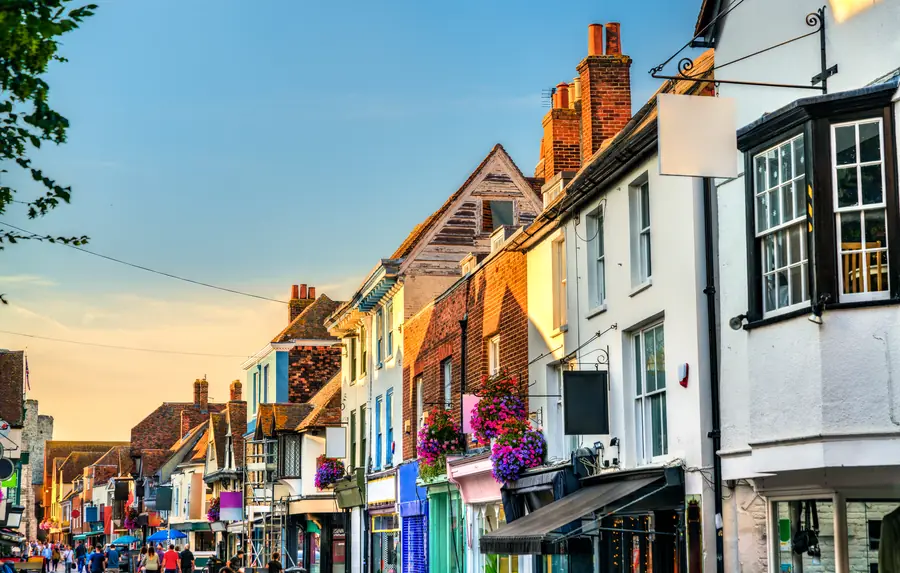
Canterbury’s old town is a walk, not a tour itinerary. The medieval centre is barely ten minutes from the Westgate to the cathedral, the High Street is semi-pedestrianised, and almost everything a first visit wants sits inside the walls or five minutes outside them. You do not need a car, a timed slot or a guidebook app. You need to know which of the lanes — Mercery, Butchery, Palace Street — to use, and which hour to use them.
This is not a cathedral article, and it is not a countryside walk. The cathedral guide covers the building; the walks guide covers the Stour to Fordwich, Blean and the Downs. What follows is the city itself: the High Street, the lanes, the walls, the river through the middle, and how to be in them when they still feel like streets.
The walled city is compact in a way that surprises people who have come from York or Chester. From the Westgate arch to Christ Church Gate is a single straightish street and a few kinks. A full circuit of the walkable walls, the High Street, Dane John and a loop along the Stour is about three kilometres and takes an hour if you do not stop. You will stop.
That smallness is the gift and the problem. It is why you can do the old town before lunch. It is also why a dozen coaches at the bus station can fill every lane that matters. The geography does not change. The hour does.
Both railway stations sit on the edge of this walk. Canterbury West is three minutes from the Westgate; Canterbury East is a few minutes from Dane John. Park and ride buses drop you in the centre. Once you are in, the car is a liability. See parking in Canterbury if you still have to bring one, then forget it.
Start at the Westgate. It is the front door. The London road still comes in under the arch, the Stour runs in front, and the High Street begins on the other side. Climb the towers if you can manage a spiral stair with no lift — the rooftop looks straight down the street you are about to walk — or save the ticket and look at the gate from the pavement. The Westgate Towers piece covers the museum; this walk only needs the arch.
Through the gate, St Peter’s Street is the High Street under another name, timber and brick, the river close on the left. The Old Weavers House sits on the water a little further along, which is the postcard, and it is also a working restaurant. Look at the building from the bridge; do not let it eat the morning.
Canterbury High Street runs the length of the walled city, slightly bent, slightly downhill towards the Westgate, and it is doing three jobs at once: a shopping street, a tourist street, and the way the city walks to work.
The middle stretch is chains and the gravity of Whitefriars, the shopping centre on the southern side. That is useful in rain and of no interest to this walk. The better ground is at the two ends and in the first turning off.
At the western end, St Peter’s Street still feels like a street of buildings rather than a parade. At the eastern end, Burgate and Sun Street take the cathedral money. Between them, the High Street is for moving along, not for lingering, except at the Beaney, the city’s free museum and art gallery, which is the one doorway on this street worth losing twenty minutes to.
Markets set up on the High Street on trading days. They are a delay, not a destination. Walk through, buy fruit if you want it, and get off into a lane.
The old town is the lanes. The High Street is how you reach them.
Butchery Lane runs off the High Street towards the cathedral’s south side. It is narrow, slightly crooked, and it frames a view of the cathedral that is better than the one from the gate. The Roman Museum is here, underground, on the Roman street of Durovernum — a paid stop, compact, and the right indoor forty minutes if the lane is wet. You can walk Butchery Lane without going in.
Mercery Lane is the postcard slot: a tight opening onto Christ Church Gate. It is also the place where people stop dead to take that photograph, which is why it fails as a thoroughfare from late morning. Use it early, or use it as a look rather than a route.
Palace Street, Sun Street and the Borough hold the independents, the bookshops, the cafés the students actually use, and most of what is interesting to eat if you have read where to eat. They run north of the High Street towards Northgate. In term time they have an evening. In August they have visitors who have escaped Burgate. Either way they are the streets that still work when the spine does not.
South of Whitefriars, inside the wall, Dane John Gardens are the old town’s other lung. The mound at the centre was a Roman cemetery, then a Norman motte, then a Georgian pleasure garden. Climbing it takes two minutes and gives you the cathedral above the rooftops, which is the free counterpart to the Westgate roof. The name is probably donjon. There was never a John.
The city wall along the eastern edge of the gardens is the best-preserved stretch you can walk on. Burgate round towards St George’s is the section that still feels like a defence rather than a retaining wall. On one side, the gardens and the rooftops; on the other, the ring road, which is not romantic and is extremely clear about how the city grew.
Around half the Roman and medieval circuit survives. You cannot walk a complete round on the wall-walk — streets and missing stretches break it — but you can join the fragments into a loop that takes in Dane John, the bus station corner, Burgate and back. It is free. It is the walk that makes sense of the lanes, because from the wall you see that they are the inside of a camp.
The river is the western edge of the old town, not a countryside walk. From the Westgate, Westgate Gardens occupy the ground between the split channels: lawns, the city wall, the oriental plane, punts passing under the willows. Free, level, and the place to sit when the lanes have been enough.
Downstream, the path continues towards Toddlers Cove and out of the city. Upstream, and through the middle, the Stour is the back of the High Street — mill races, buildings on arches, Greyfriars Chapel standing over the water, the working side of a city that turned its face to the street four hundred years ago. The way to see that stretch is from a punt, not from a towpath. Our punting guide is the river as a visit.
You can, though, get down to the water at the bridges without paying. The Franciscan Gardens and Abbots Mill Garden are small, free, and missed. They are the old town’s quiet, and they sit in the same few hundred metres as the Weavers House.
Do not confuse this with the walk to Fordwich. That is five kilometres of water meadow and a different page.
Coaches set down at the bus station, at the south-eastern edge of the centre, a short walk from Dane John and a slightly longer one up Burgate to the precincts. From late morning through mid-afternoon in season, that walk is the crush. Sun Street, Mercery Lane and Christ Church Gate take the arrival. The nave takes it twenty minutes later.
You cannot out-park this. You can out-walk it.
Before ten, the High Street is a high street. The lanes are empty enough to look up. The Westgate roof is yours. The gardens have benches.
After four, and better after five, the day-trippers are moving back towards the bus station. The light on the western streets is the reason to save the Westgate end for the end of the day. Dusk on the High Street — shopfronts, the slight bend, Bell Harry over the chimneys — is the old town as a place rather than a circuit.
Evensong empties the cathedral of everyone except the people attending, which thins the precincts even if it closes the visitor route. It is free, and it is the one scheduled event that works in your favour.
Weekday mornings, almost any month. Winter afternoons. Sundays before lunch, before the afternoon visitors from London arrive on the high-speed. Term-time evenings on Palace Street, when the students have the cafés and the cathedral quarter has gone quiet.
They do not work: bank-holiday afternoons, the first fortnight of August between eleven and three, wet Saturdays when everyone is under the same jetties, and the minutes after a coach has emptied on Burgate.
Rain changes the texture more than the route. The lanes are short enough to dart between doorways. The Beaney is free and dry. The Roman Museum is underground by definition. The wall-walk is miserable in a south-westerly. Use the streets, skip the ramparts, sit out a shower in a pub that was here when the gate was a gaol. See Canterbury in the rain.