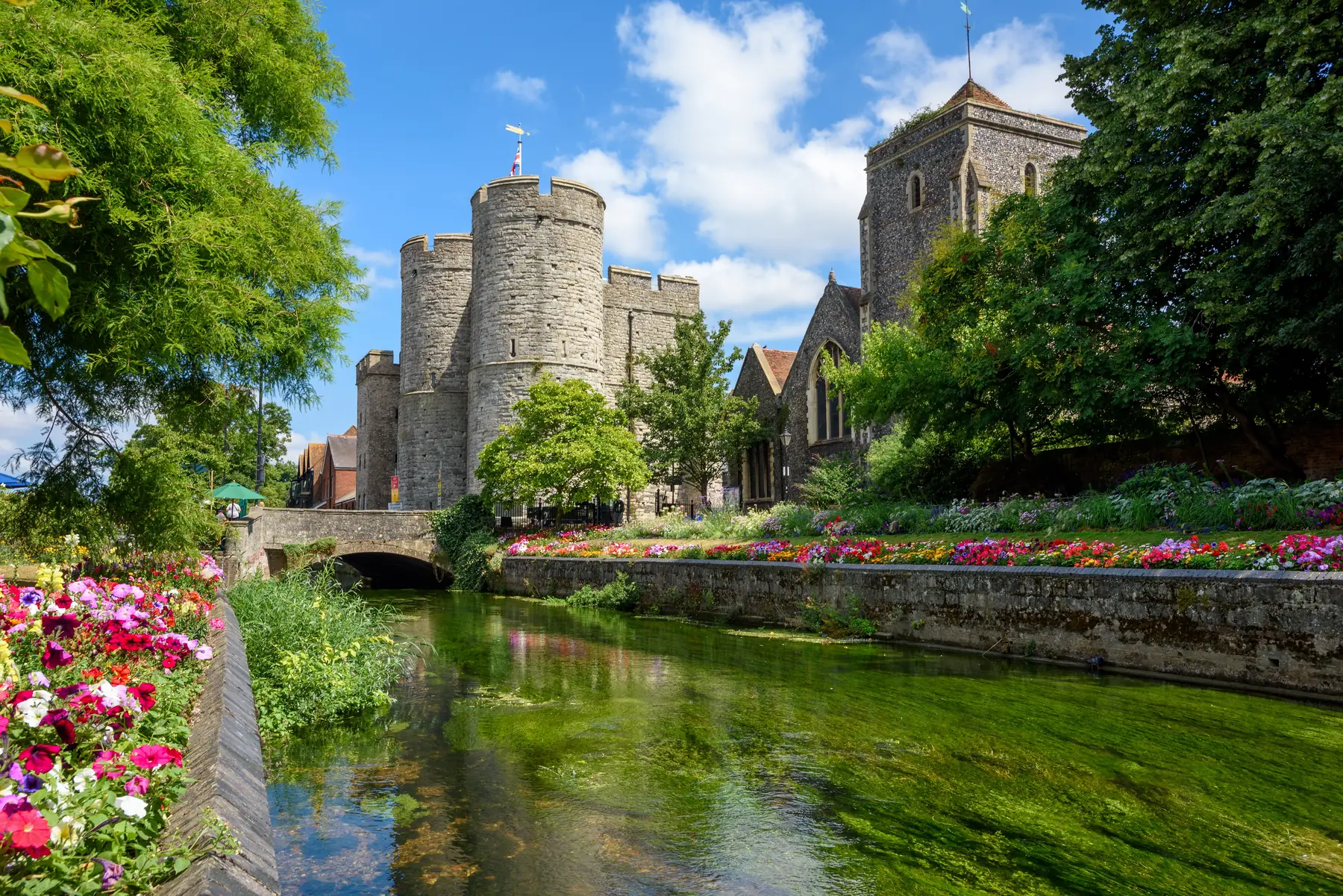
The Westgate straddles the western end of Canterbury’s High Street, and the road still runs through it. Two drum towers of Kentish ragstone, a gatehouse between them, the Great Stour in front, the cathedral somewhere down the street behind. It is the largest surviving medieval city gate in England, and the only one of Canterbury’s gates left. The rest were demolished. This one came within a single vote of the same fate.
It is now a modest independent museum with a rooftop. The climb is a spiral stair with no lift. The view is the reason to go up. Combine it with Westgate Gardens and the river, which are immediately through the arch and free, and you have the best half-hour at this end of the city.
Canterbury had a ring of gates in the medieval walls. They came down, one by one, as the city decided that traffic mattered more than masonry. In 1859 the council debated pulling the Westgate down to let a circus caravan through. The proposal was defeated by one vote. That is not a colourful detail. It is why there is still a gate to climb.
What you are looking at is therefore a survivor twice over: of the centuries that took the other gates, and of a Victorian afternoon that nearly took this one. The road underneath is the old London approach — St Dunstan’s Street, then St Peter’s Street, then the High Street — and traffic still uses the arch. Standing on the pavement you feel that. Standing on the roof you see why it was worth a vote.
It is Grade I listed, a scheduled monument, and not a council museum. A small private operator runs the towers alongside the neighbouring pub and coffee house. That is relevant later, when you come to hours.
The present gate went up around 1380 for Archbishop Simon Sudbury, replacing an earlier Roman and Norman gate on the same crossing of the Stour. The French were raiding the Kent coast. The Hundred Years’ War made a western gate that could actually fight a sensible expense.
The design is up to date for its date. Gun ports for early cannon — among the earliest in England — sit in the drum towers. There is a portcullis slot, and murder holes in the vault over the passage, so that anyone who got through the first door could be dealt with from above. Each tower had a ground-floor room with a fireplace. The first floor is a large chamber over the arch, with a later perpendicular window looking east, down the street, towards the cathedral.
Sudbury did not enjoy his gate for long. As Lord Chancellor he was blamed for the poll tax, and in 1381 the Peasants’ Revolt took him from the Tower of London and beheaded him on Tower Hill. His head, by long tradition, is at St Gregory’s in Sudbury, Suffolk. The gate kept his name.
Repairs in the 1470s and 1480s answered another invasion scare. The east window was added around 1491. After that the military threat lessened and the building began its second life.
The Westgate became the city gaol, and it remained one into the nineteenth century. The cells are part of the visit. They are not a reconstruction. They are the rooms.
That is the layer most people remember after the view: a defensive gate that turned into a prison because a stone tower with one way in is already most of a gaol. The museum leans into this — crime and punishment, the cells, the later police use — and it is why a visit is more than a staircase and a panorama.
In both world wars the towers went back to work, as a lookout and an air-raid post. The museum opened as a public collection in 1906, closed when the wars needed the roof, and has had a stop-start century since: council, trust, closure, and the current private lease. It is a small English museum story as much as a medieval one.
The Westgate Towers Museum & Viewpoint occupies the guardroom, the cells and the rooms in the towers. It is small. It is independent. It is better than its size suggests, which is the usual verdict on small museums that are well done.
The exhibits run in four directions: the gate itself and the city’s defences; crime and punishment; the building’s own history; and a Magna Carta strand that belongs to Canterbury’s wider medieval story rather than to this one doorway. There is armour to look at, and there are the murder holes to look down through, which children understand immediately.
Do not come expecting the Beaney or the Roman Museum. Come expecting forty-five minutes in a real building, with the original rooms doing most of the work. Visitors regularly describe it as surprisingly interesting. That is the correct review of a museum that has not been padded.
Tickets are sold at the top of the first stairs, not in a separate visitor centre. Card payment has been the rule in recent seasons. There is sometimes a deal if you have already eaten in the neighbouring pub or coffee house; that is an operator offer, not a civic right, and it changes. Do not invent a price from this paragraph. Check the museum’s own site the morning you go.
The reason most people climb. The open roof gives a view straight down the length of the High Street to Bell Harry and the cathedral, over Westgate Gardens and the split channels of the Stour, and across the medieval street pattern that every other viewpoint in the city only hints at.
It is the best public view in Canterbury. Dane John’s mound is free and good; this is better, and it faces the way the city actually runs. You see why the High Street is a processional route, why the gate was worth defending, and why a circus caravan in 1859 was a stupid reason to knock it down.
The battlements are exposed. They are slippery when wet. Wind on the roof is out of proportion to the street below. Hold children. Do not treat the parapet as a seat.
The view is why a shower is survivable and a downpour is not. In rain, the museum interiors still work; the roof becomes a coat and a careful step. Our rain guide lists better bunkers if the sky has properly gone.
Access is a narrow spiral staircase. There is no lift. Doorways are medieval-narrow because the building is listed. The museum and the viewpoint are both up the stair, so the whole visit is inaccessible to anyone who cannot manage several flights of stone spiral.
That is not a failing of the operator. It is the building. If stairs are the problem, do not buy a ticket in the hope that the ground floor will be enough. Look at the gate from the street, walk through the arch into the gardens, and spend the hour on the Stour instead. The gardens are level, free, and the right consolation.
The Pound, the bar and kitchen in the adjacent building, is a separate operation and is the accessible place to sit at this end of the city. The towers are not.
The Westgate is not a half-day. It is a stop. The stop makes sense when you join it to what sits against it.
Westgate Gardens run along the river immediately through the arch: lawns, willows, the city wall along one side, and the oriental plane that is the finest tree in Canterbury. Free, open, and the place to sit after the spiral stair.
Punting launches from nearby. The city stretch of the Stour passes the gate’s own bridge, the backs of the High Street, Greyfriars and the Weavers House. A guided trip is about forty minutes. Our punting guide covers who runs what.
The Goods Shed, five minutes north by Canterbury West station, is the lunch. The High Street runs east from the arch to the cathedral in ten minutes, which is the walk this gate was built to control. Our old-town walking guide starts here for that reason.
Do the towers first if you are going up, while the legs are fresh and the roof is not yet a queue of two. Then the gardens. Then the river or the street.
The museum is a small independent attraction, not English Heritage and not the cathedral. Days and hours vary. In recent seasons it has not been a seven-day operation, and winter has closed extra weekdays. Events in the towers — escape rooms, private bookings — take the museum off the timetable without much warning.
Check the operator’s own page the morning you go. Do not build a timed morning around a rooftop that is shut. If it is closed, the gate is still there, the arch is still the way into the gardens, and you have lost a viewpoint rather than a day.
Admission is modest by cathedral-city standards. That is not a price. It is a character. Members’ cards for national outfits do not cover it. National Art Pass has, at times, offered a discount; confirm if you hold one.