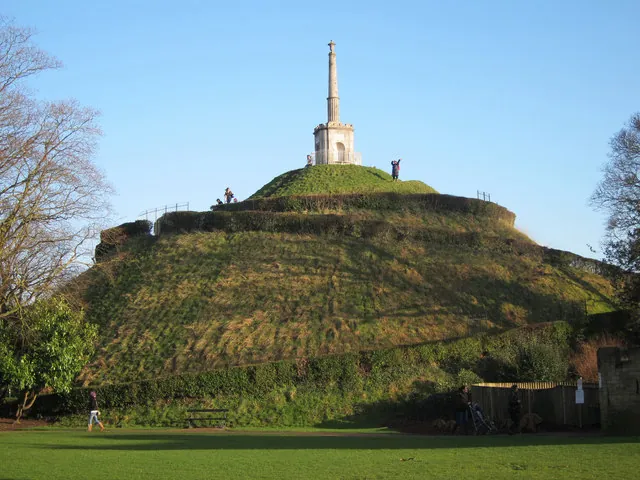
Dane John Gardens run along the inside of Canterbury’s southern city wall, five minutes from the cathedral, and they have had three entirely different lives.
The Dane John Mound at their centre began as a Roman burial mound — part of a cemetery outside the walls of Durovernum Cantiacorum. In the eleventh century the Normans raised it and used it as the motte of a motte-and-bailey castle. And between 1790 and 1803 it was landscaped into a civic pleasure garden by the city’s mayor, Alderman James Simmons, who planted the avenue of trees and put a monument on top.
The name has nothing to do with anyone called John. It is generally taken as a corruption of donjon, the Norman word for a keep.
The mound, which you climb by a spiral path to a monument at the top and a view over the city — the cathedral above the rooftops, the wall below, and the ring road beyond it. It takes two minutes and it is the best free view in central Canterbury.
The avenue of limes planted by Simmons, running the length of the gardens.
A fountain, formal beds, mown lawns and a bandstand.
The city wall along the eastern edge, which you can walk along — this is the best-preserved stretch of Canterbury’s Roman and medieval defences, and the walk gives a view down into the gardens on one side and out over the city on the other.
A memorial to Christopher Marlowe, born in Canterbury in 1564.
Worth flagging because it has affected visits. The gardens underwent a substantial restoration and redevelopment in recent years, funded through a regeneration scheme, which involved a long closure and was not universally popular locally — a familiar pattern with municipal heritage projects.
The work is largely complete. Check locally before travelling if the gardens are the specific reason for your trip.
A short walk with a view — the mound and the wall together take twenty minutes.
Sitting down. The gardens are the nearest green space to the bus station and the Whitefriars shopping area, and they are what the city centre uses.
Events. Bands play in the summer, and the gardens host a run of city events through the year.
Understanding the city. Standing on a Roman burial mound that became a Norman castle inside a wall on Roman foundations, looking at a cathedral founded in 597, is the fastest available summary of why Canterbury is what it is.
Free, open at all times.
Access: the gardens are level; the mound is climbed by a spiral path which is gradual but unsurfaced in places.
Facilities: toilets nearby; cafés and the Whitefriars centre a few minutes away.
Safety: it is a city-centre park adjoining the bus station and the usual urban common sense applies after dark.
On foot: five minutes south of the cathedral, immediately beside the bus station.
By bus: the bus station is adjacent, which makes this the first green space most arriving visitors see.
By train: Canterbury East is a five-minute walk.
By car: park and ride, as everywhere in Canterbury.
The city walls run from here around the eastern side of the city towards Burgate and the cathedral quarter — the best-preserved circuit in the south-east and free to walk.
The Whitefriars shopping centre and the High Street are immediately north, and the Marlowe Theatre and the river are ten minutes away.
A Roman burial mound, reused as the motte of a Norman motte-and-bailey castle, and landscaped into a public garden between 1790 and 1803.
It is generally taken as a corruption of donjon, the Norman word for a keep — not a reference to anyone named John.
Yes, by a spiral path to a monument at the top, in about two minutes. The view over the city is the best free one in the centre.
Yes, free and open at all times.
Yes — the stretch alongside the gardens is the best-preserved part of Canterbury’s defences and connects round the eastern side of the city.