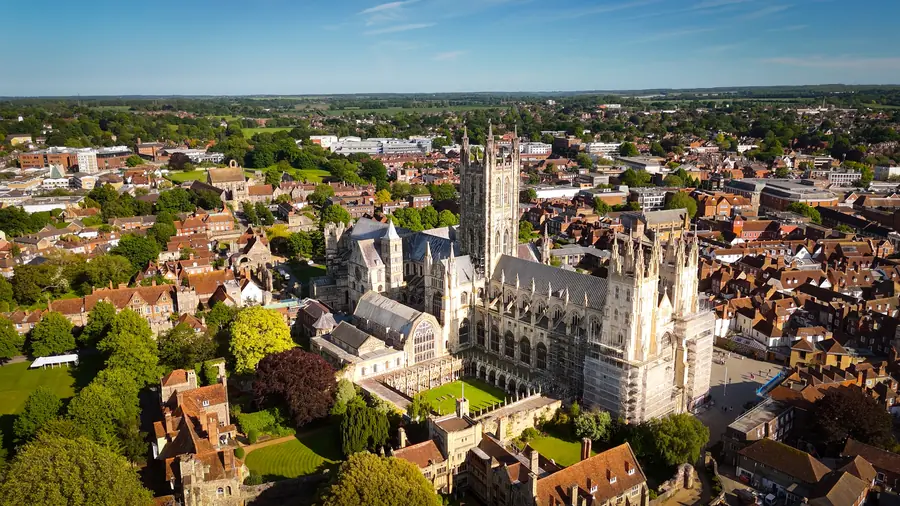
Canterbury Cathedral is the seat of the Archbishop of Canterbury, the mother church of the worldwide Anglican Communion, and part of a UNESCO World Heritage Site along with St Augustine’s Abbey and St Martin’s Church. Its formal title is the Cathedral and Metropolitical Church of Christ, Canterbury.
It stands on the site of one of the oldest Christian foundations in England — St Augustine founded a cathedral here in 597 — and it has been a place of pilgrimage since 1170, when four knights killed an archbishop in the north-west transept.
Visitors consistently say they wish they had allowed longer. Three hours is a realistic minimum.
The crypt is the oldest substantial part: Norman, low, heavy, with carved capitals of animals and monsters, and one of the largest Romanesque crypts in Europe.
The quire and east end were rebuilt after a fire in 1174 by William of Sens and, after he fell from the scaffolding, by William the Englishman. What they built is the earliest full Gothic architecture in England — and it was built at speed, because the cathedral urgently needed somewhere spectacular to house Becket’s shrine.
The nave was rebuilt in the late fourteenth century by Henry Yevele, the great royal mason, in the Perpendicular style. Walking in through the west door and looking up its length is the best moment in the building.
Bell Harry, the central tower, went up around 1500 and is what you see from every approach to the city.
The Martyrdom — the north-west transept where Thomas Becket was killed on 29 December 1170. It is marked simply, with a modern sculpture of sword points, and it is the quietest corner of the cathedral.
The site of the shrine in the Trinity Chapel, where the shrine stood from 1220 until Henry VIII destroyed it in 1538. It is marked by a single candle on bare pavement, with the floor around it worn into hollows by four centuries of pilgrims.
The Miracle Windows — twelfth- and thirteenth-century stained glass in the Trinity Chapel telling the stories of cures attributed to Becket. Among the oldest surviving glass in England, and the detail most visitors walk straight past. Binoculars help.
The Black Prince’s tomb — Edward of Woodstock under a gilt-bronze effigy, with replicas of his funeral achievements above.
Henry IV, buried nearby with Joan of Navarre — the only monarch buried at Canterbury.
The cloisters, with hundreds of carved and painted bosses, and the Chapter House with its wooden roof.
Tickets: there is an admission charge for visitors. Services are free to attend, and evensong — sung most days in term by the cathedral choir — is the building doing what it was built for and the best free hour in the city.
Time: two hours minimum, three to do it properly, more with a guided or tower tour.
Tower tours climb the Corona Tower at the east end; book ahead, and expect a spiral staircase.
Opening varies. Services, ordinations and events close sections at short notice — check the day’s arrangements.
Entry is through Christ Church Gate on Burgate, itself worth stopping to look at.
Photography is permitted in most of the building but restricted in the crypt.
Accessibility: the nave and much of the ground level are accessible; the crypt and towers involve steps.
Both railway stations are under ten minutes’ walk. Do not attempt to drive to it — use one of the three park and ride sites at Wincheap, New Dover Road or Sturry Road.
Our cathedral guide sets out a longer visit, and the two other World Heritage Site components — St Augustine’s Abbey and St Martin’s Church — are both within fifteen minutes on foot.
Two hours minimum, three to do it properly, and more with a tower tour.
No, there is an admission charge for visitors — but attending a service, including evensong, is free.
In the north-west transept, now called the Martyrdom, on 29 December 1170.
No. Henry VIII had it destroyed in 1538. Its site in the Trinity Chapel is marked by a single candle.
Medieval stained glass in the Trinity Chapel depicting cures attributed to Becket — among the oldest surviving glass in England.