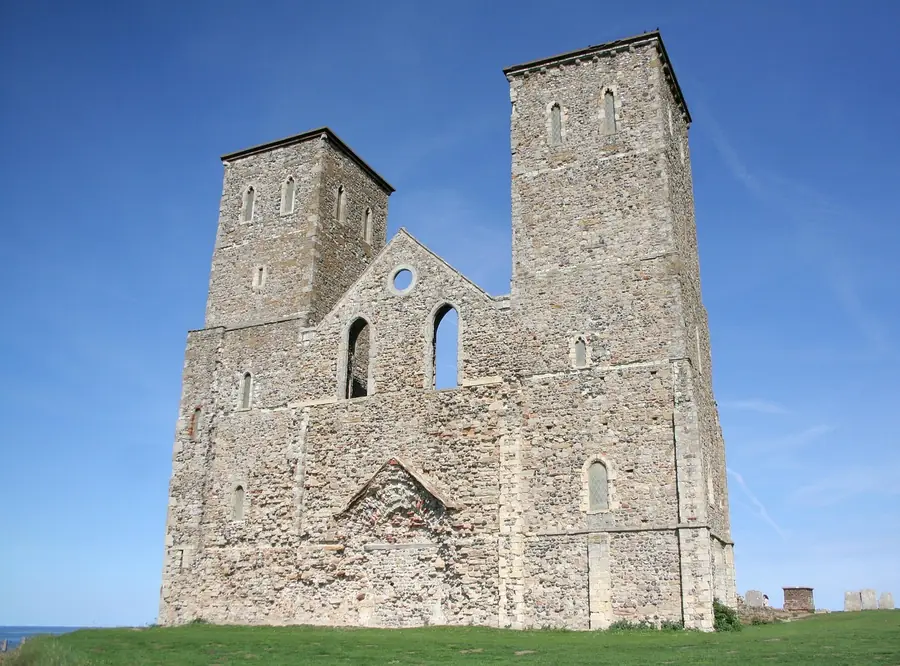
Reculver stands on the north Kent coast fourteen kilometres north-east of Canterbury, and it is the most striking free sight in this part of England: the twin west towers of a ruined Norman church, standing alone on a low cliff above the sea, inside the surviving walls of a third-century Roman fort.
There is not a great deal to it. That is rather the point, and the visitors who enjoy it most are the ones who understood that before setting off.
Regulbium, the Roman fort, was built in the early third century as one of the Saxon Shore forts — a chain of coastal strongholds guarding the south-east against seaborne raiders. It stood at the northern entrance to the Wantsum Channel, the sea passage that then separated the Isle of Thanet from the Kentish mainland and carried shipping between the Thames and the Channel. Richborough guarded the southern end.
The Anglo-Saxon church was founded inside the fort walls in 669, by a priest named Bassa on land granted by the king of Kent — one of the earliest churches in England, and remains of it survive within the later building.
The Norman church was built around it, and the twin towers added in the twelfth century.
The Wantsum silted up, the channel closed, and the sea began taking the coast instead. By the early nineteenth century erosion had brought the cliff to the church door, and in 1809 the parish demolished most of the building and moved inland. The towers were kept — deliberately — because they were a navigation mark for shipping, and Trinity House bought them and built the sea defences that still hold the cliff.
That is why two towers stand on a cliff with nothing behind them.
The towers, the surviving walls and foundations of the Roman fort, the outline of the church, and a very large amount of sea and sky.
The setting is the attraction. It is exposed on all sides, the north Kent coast runs away east towards Thanet and west towards Herne Bay, and the light and the weather do most of the work. In a gale it is genuinely impressive; on a flat grey afternoon it is a couple of towers in a field.
There is a small beach below, shingle and sand, and the sea wall runs west towards Herne Bay.
Walk. The sea wall west to Herne Bay is about five kilometres, level, with the beach on one side. East, the Reculver marshes are a nature reserve with good birdwatching, and the Saxon Shore Way runs through.
Look for fossils and finds on the beach below the eroding cliff, which sheds Roman material.
Watch birds. The marshes and the shore hold waders and wildfowl in numbers, and the site is a well-known migration watch point.
Stop for lunch — there is a pub and a café by the car park.
Free — English Heritage manages the site and there is no admission charge. The car park is charged.
Open at all reasonable times; the towers themselves are fenced for safety and access inside them is occasional rather than routine.
Time: thirty minutes for the site, longer with a walk.
Facilities: toilets, a café and a pub by the car park.
Access: the site is level grass; the cliff edge is unfenced in places.
Exposure: there is no shelter whatever. Dress for it.
By car: signposted from the A299 near Herne Bay, fourteen kilometres from Canterbury.
By bus: services from Canterbury and Herne Bay.
On foot or by bike: along the coast from Herne Bay, five kilometres of level sea wall.
Yes — English Heritage manages it with no admission charge. Parking is charged.
The church was demolished in 1809 as the cliff eroded towards it, but the towers were kept as a navigation mark for shipping and given sea defences.
Regulbium, a third-century Saxon Shore fort guarding the northern entrance to the Wantsum Channel between Thanet and the mainland.
Honestly, not a great deal in the way of buildings — the setting, the sea and the walk are what people come for. It is at its best in dramatic weather.
Fourteen kilometres north-east, about twenty-five minutes by road, with buses from the city.