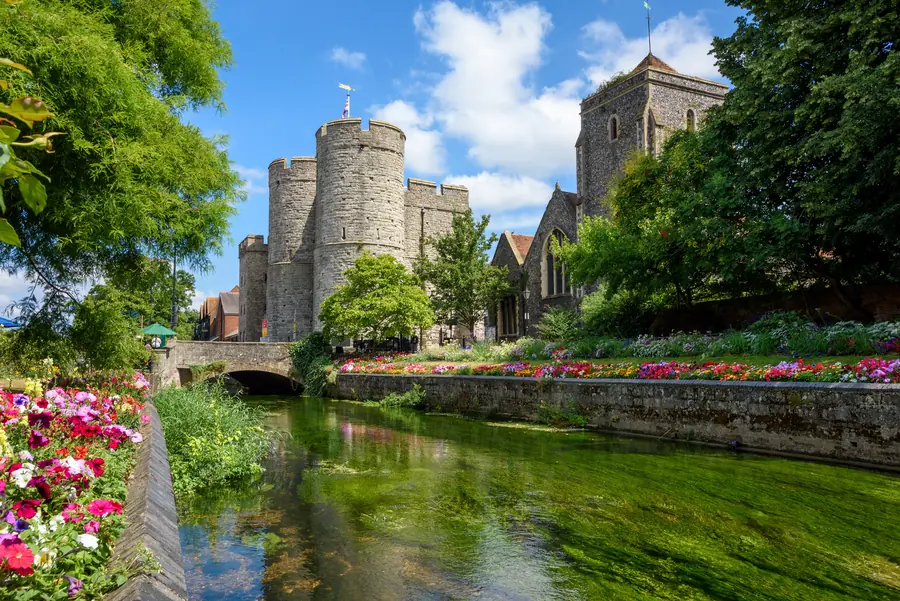
The Westgate straddles St Peter’s Street at the western end of Canterbury High Street, and it is the largest surviving medieval city gate in England — two drum towers of Kentish ragstone, sixty feet high, with a gatehouse between them and the road still running underneath.
It is also the only one of Canterbury’s original city gates to survive. The rest were demolished, and the Westgate came within a single vote of the same fate in 1859, when the council debated pulling it down to let a circus caravan through. The proposal was defeated by one vote.
It was built around 1380 by Archbishop Simon Sudbury, replacing an earlier Roman and Norman gate, at a time when the French were raiding the Kent coast and Canterbury needed defending properly. The design is up to date for its date: gun ports for early cannon — among the earliest in England — a portcullis, murder holes above the passage, and thick walls.
Sudbury did not enjoy his gate for long. As Lord Chancellor he was held responsible for the poll tax, and in 1381 the Peasants’ Revolt caught him in the Tower of London and beheaded him on Tower Hill. His head is, by long tradition, kept at St Gregory’s Church in Sudbury, Suffolk.
The gate later became the city gaol, which it remained until the nineteenth century — the cells are part of the visit.
Small, independent and better than its size suggests. It occupies the guardroom and the cells and covers the gate itself, Canterbury’s medieval defences, the city’s history and the building’s long service as a prison. There is armour, and there are the murder holes to look down through.
Visitors regularly describe it as surprisingly interesting, which is the most common verdict on small museums that are well done.
The reason most people climb up. The open rooftop gives a view straight down the length of the High Street to the cathedral, over the Westgate Gardens and the Stour, and across the medieval street pattern.
It is the best view of Canterbury available to the public, and the climb is a spiral staircase of moderate length.
Time: forty-five minutes to an hour.
Cost: modest.
Access: a spiral staircase with no lift. The museum and the viewpoint are both up it, so the whole visit is inaccessible to anyone unable to manage stairs.
Opening: run privately alongside the neighbouring café and bar; days and hours vary, so check before travelling.
Westgate Gardens are immediately through the arch — the loveliest public space in Canterbury, running along the Great Stour with an enormous oriental plane tree in the middle.
The city walls run from here around the eastern side of the city and are walkable in stretches.
Punting on the Stour launches from nearby, and the punt route passes under the gate’s own bridge.
The High Street runs east from the arch straight to the cathedral, which is ten minutes’ walk.
On foot: at the top of St Peter’s Street, five minutes from the cathedral and three from Canterbury West station — turn right out of the station, left into St Dunstan’s Street, and you walk under it.
By car: do not. Use park and ride.
It was built around 1380 by Archbishop Simon Sudbury, replacing an earlier gate.
Yes — it is the only one of Canterbury’s medieval city gates to survive, and the largest surviving city gate in England.
Yes. It served as the city gaol into the nineteenth century, and the cells are part of the museum.
Yes — the rooftop gives the best public view in Canterbury, straight down the High Street to the cathedral.
No. Access is by spiral staircase only.