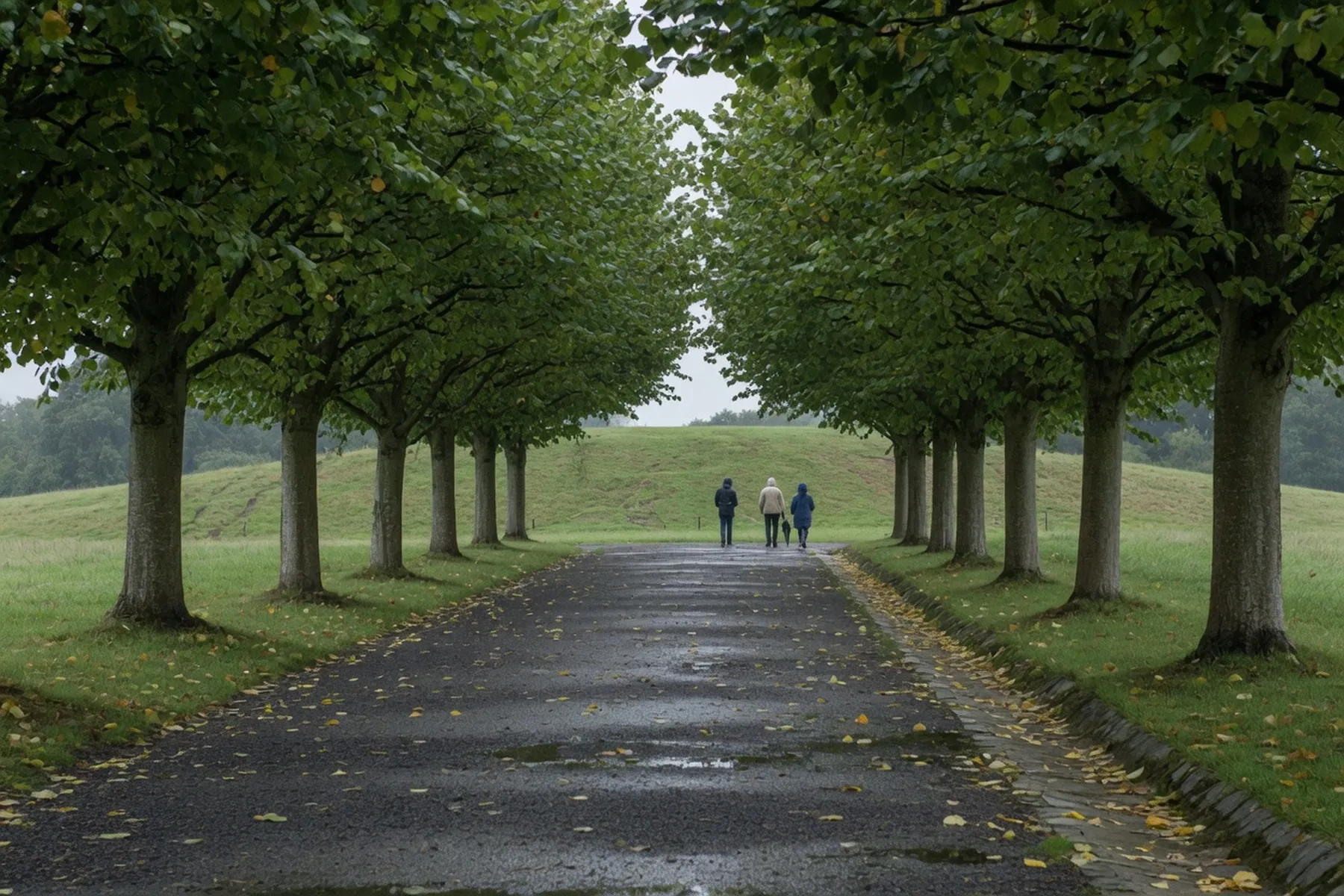
Canterbury still keeps a long stretch of its medieval wall, and the best place to begin a circuit of it is the gardens that sit inside it. Dane John Gardens, just south of the centre, hold the city’s oldest earthwork, a walkable length of rampart and a surprising amount of history under the lime trees. Everything below can be seen in a single unhurried morning, and none of it needs a ticket.
The wall you see today follows the line the Romans set when they built around a much older mound, and medieval masons rebuilt on their fabric and foundations. Roughly over half the circuit survives, mostly on the southern and western sides of the city, with the rest lost to later widening and demolition. The best single view of how it all fits together is from the gardens: wall, embankment and mound sit within a few hundred yards of one another, which is exactly why the walk works as one outing. Between the mound and the wall the archaeology society records a buried Roman bank, the remains of the earlier earthwork the Roman masons were building around, so even the flat ground you cross carries a layer of the story the wall tells above it.
The name is the first thing to get right. Dane John is a corruption of the Norman French “donjon”, a castle keep, and has nothing to do with Danes, whatever the older signboards say. The mound itself is older than either: a late Iron Age or early Romano-British burial mound, which the Romans chose to take inside their wall. After 1066 the Normans used it as Canterbury’s first motte-and-bailey castle, before a stone castle to the west replaced it from 1086. The archaeology society notes that visible Norman traces had gone by the late sixteenth century, leaving a grassy hill that has carried many jobs since: common land, an archery ground, a plague quarantine site in the 1640s, and livestock markets under a Charles II charter of 1684.
The gardens as a designed place are the work of one man. Around 1790 Alderman James Simmons leased the land and spent about £1,500 between then and 1803 on tree-lined walks, terraces, planting and a spiral path up the mound, which he also reshaped and raised. The long avenue of lime trees that runs through the middle is now more than two hundred years old, and the pinnacle on top of the mound was put there in 1803 to commemorate his gift of the gardens to the city. This is not a park that accreted; it was composed, and the layout still reads that way.
Work through them slowly and the garden becomes a small museum. The pinnacle is the Simmons memorial. The Weekes Sundial of 1840 survives only as a copy, and the ornate fountain of the 1850s has had a complicated recent life. The Boer War memorial, in Cornish Polyphant stone from 1903, is by W. D. Caroe with lettering by Eric Gill, and remembers The Buffs; it was restored in 1999. The cast-iron bandstand was sold for scrap in the Second World War and re-created as a replica in 1999, in the Lottery-funded restoration that also added Joss Smith’s “Font” fountain and “Silent Table” and the “Peace Pavement”. During the war the garden was drawn into the city’s defences, with shelters built into the wall embankment near the bandstand to store ammunition.
The rampart along the south side of the gardens is the straightforward stretch: you can walk it where it is open, with the wall on one side and the avenue below. From there the wall runs down toward Broad Street, where the official circular route has you keeping “the walls of the city to your left”, and on past the Castle toward Westgate. Some sections you walk on top of, others you walk beside; where the rampart walk is fenced or uneven, the path at its foot does the same job. Check the council or Explore Kent pages for any current closures before setting out, because fencing changes with maintenance.
Westgate is the one medieval gate that survives, and it deserves its own visit — see the site’s Westgate Towers article rather than re-reading the story here. The others are worth knowing because the names still hang over the streets: Worth, Riding, London and Queningate all had Roman gate remains, all but London reused in the medieval period, while Burgate stood until it was demolished in the late eighteenth century. Walking the wall now is partly an exercise in noticing where the gaps are.
The gardens are open all hours and are free, with toilets, a disabled toilet, picnic tables, a play area, viewpoints and dog-waste bins, and dogs are allowed. One thing has changed since the renovation: the gates are locked from 10pm to 4am on Friday and Saturday nights, so an evening walk through the gardens is fine on any other night but not those two. The 2026 works also left a new cafe built but not yet fitted out, and the fountain and lights waited on a power-cabinet replacement that was due within a month of the May reopening — so check the council’s page before relying on the fountain or the cafe, and treat either as a bonus rather than the plan.
The gardens sit at CT1 2QX, close to Canterbury East station via a footbridge over the ring road. Begin at the mound end of the avenue, walk the rampart, then drop down through the gardens toward Westgate and the river, which is the natural way to join this to the walking the old town and walks around Canterbury pieces. From Canterbury East the footbridge lands you almost at the gate, so the walk starts properly the moment you leave the platform. The Dane John Gardens page on this site has the garden itself in more detail.
If the walls leave you wanting the full circuit, Explore Kent publish an official circular called the Canterbury City Pilgrim Tour: 3.7 miles (5.9 km) that takes in the wall line from Dane John around to Westgate and beyond, with the city on one side throughout. It is the answer when the garden walk feels too short, and their page carries the route map worth printing before you go.
The gardens host Canterbury’s Cooking food festival from 25 to 27 September 2026, free to enter, with the Canterbury Ale and Cider Festival alongside it; the organiser is Zoom Events, and every stall and timing detail sits on their page, so check there rather than taking one from here. The bandstand has traditionally hosted concerts through the summer, but no autumn programme has been announced, so do not plan around one. For everything else, the city’s own events listings at canterbury.co.uk are the place to look.
The routes through the gardens are well surfaced, and Explore Kent describe them as suitable for pushchairs and wheelchairs, with no stiles or narrow kissing gates in the way. The rampart itself is the exception: it is the top of an old bank, so it is steeper and less even than the avenue, and the flat path at its foot is the reliable way if wheels are part of the day. Canterbury’s walled centre is also a legally protected Area of Archaeological Importance, and the walls are a Scheduled Monument, which is worth knowing only because it is why the surfaces are looked after rather than tarmacked over.